How To Pick The Right Blackjack Table
Basic Blackjack Strategy – House Edge & Payouts. An extreme example is 6/5 blackjack. This is a variation of blackjack that pays out 6 to 5 on a blackjack instead of the usual 3 to 2 payout. At most blackjack tables, if you bet $100 on a hand, and you get a blackjack, you.
Advertisement Casino royale online usa.
Millions of players have heard the message that of all the casino table games, blackjack is the one that it is possible to beat. A practical system for counting cards in blackjack to gain an edge over the casino was made available to the public in the early 1960s. As it happened, few players ever really learned to beat the dealer. Furthermore, playing conditions have changed since then. Some tables use more than one deck at a time or cut a percentage of the cards out of play so that a card counter never sees them.
Even though most players don't have the skill to win consistently, the belief that blackjack can be beaten was enough to spark a boom in the game. Blackjack is by far the most popular casino table game in the United States, with more players than craps, roulette, and baccarat combined.
A lot of people don't have either the patience, persistence, and concentration necessary for card counting or the bankroll to make it effective. But they can still narrow the house advantage to less than 1 percent in blackjack. The secret is to learn basic strategy for hitting, standing, doubling down, and splitting pairs. A little time spent learning to play well can make your money go a lot farther in the casino. In this article, you will learn the fundamentals of blackjack, as well as some strategies to increase your odds of winning. Let's get started by learning how to play the game:
The online casino is licensed by the United Kingdom Gambling Commission (UKGC) to operate in the UK and by the Malta Gaming Authority for jurisdictions outside the UK. Prime Slots is owned by Prime Online LTD and is operated by Aspire Global International limited. 
- How to Choose Blackjack Guide Chart The charts you use will be the same whether you play in an online casino or a land-based facility. However, keep in mind that you should use different charts for playing with single and multiple decks.
- Apr 16, 2012 The Day I Started Winning At Blackjack. The wrong table and then finding and sitting down at the right table. Failed to pick the right game with the right rules.
- The Cost Benefit of Rule Variations) I got asked the other day, 'How do you know what table to play when playing Blackjack?' It’s an interesting question that not a lot of folks know: Which of the many Blackjack tables in the pit should you choose to play at?
- The last thing you want to do on your first visit to the blackjack table is blow your budget. Decide on a bankroll and stick to it. Some of the most disastrous nights at the casino can be down to.
- Each blackjack table has five to seven seats for players and these are set up in front of the betting rectangle or circle that is drawn onto the table. The seat immediately to the dealer’s left is known as first base and the seat to the dealer’s right is known as third base.
Rules
Blackjack is played with one or more standard 52-card decks, with each denomination assigned a point value. The cards 2 through 10 are worth their face value. Kings, queens, and jacks are each worth 10, and aces may be used as either 1 or 11. The object for the player is to draw cards totaling closer to 21, without going over, than the dealer's cards.

The best total of all is a two-card 21, or a blackjack. Blackjack pays 3-2--that is, a two-card 21 on a $5 bet will win $7.50 instead of the usual $5 even-money payoff on other winning hands. However, if the dealer also has a two-card 21, the hand pushes, or ties, and you just get your original bet back. But if the dealer goes on to draw 21 in three or more cards, your blackjack is still a winner with its 3-2 payoff.
The game is usually played at an arc-shaped table with places for up to seven players on the outside and for the dealer on the inside. At one corner of the table is a rectangular placard that tells the minimum and maximum bets at that table, as well as giving variations in common rules. For example, the sign might say, 'BLACKJACK. $5 to $2,000. Split any pair three times. Double on any two cards.' That means the minimum bet at this table is $5 and the maximum is $2,000. Pairs may be split according to the rules described below, and if more matching cards are dealt, the pairs may be split up to three times for a total of four hands. The player may double the original bet (double down) and receive just one more card on any two-card total.
Most games today use four, six, or eight decks. After being shuffled, the cards are placed in a receptacle called a shoe, from which the dealer can slide out one card at a time. Single- or double-deck games, most common in Nevada, but also popular in Mississippi and some other markets, may be dealt from the dealer's hand.
Play begins when you place a bet by stacking a chip or chips in the betting square on the table directly in front of you. After all bets have been placed, each player and the dealer are given two cards. In a shoe game, all player cards are dealt faceup, and the players are not permitted to touch their cards. In a single- or double-deck game dealt from the hand, cards are dealt facedown and players may pick them up with one hand. Either way, one of the dealer's cards is turned faceup so the players can see it.
Once the cards have been dealt, players decide in turn how to play out their hands. After all players have finished, the dealer plays according to set rules: The dealer must draw more cards to any total of 16 or less and must stand on any total of 17 or more. In some casinos, the dealer will also draw to 'soft' 17 -- a 17 including an ace or aces that could also be counted as a 7. The most common soft 17 is ace-6, but several other totals, such as ace-3-3 or ace-4-2, on up to ace-ace-ace-ace-ace-ace-ace in a multiple deck game, are soft 17s.
Hit: If you hit, you take another card or cards in hopes of getting closer to 21. If the player's total exceeds 21 after hitting, the player is said to 'bust' and loses the bet. In shoe games, the player signals a hit by pointing to his cards or scratching or waving toward himself. In facedown games, the player signals a hit by scratching the table with the cards. Verbal calls to hit are not accepted -- signals are used for the benefit of the security cameras above the table, so a taped record is on hand to settle any potential disputes.
Stand: If you stand, you elect to draw no more cards in hopes that the current total will beat the dealer. Signal a stand by holding a flattened palm over your cards in a faceup game or by sliding your cards under your bet in a facedown game.
Double down: You may elect to double your original bet and receive only one more card regardless of its denomination. Some casinos restrict doubling down to hands in which your first two cards total 10 or 11. Others allow you to double on any two cards. Double down by taking a chip or chips equal to the amount of your original bet and placing them next to your bet. In a facedown game, at this point you also need to turn your original two cards faceup.
Split: If your first two cards are of the same denomination, you may elect to make a second bet equal to your first and split the pair, using each card as the first card in a separate hand. For example, if you are dealt two 8s, you may slide a second bet equal to the first to your betting box. The dealer will separate the 8s, then put a second card on the first 8. You play that hand out in normal fashion until you either stand or bust; then the dealer puts a second card on the second 8, and you play that hand out.
Insurance: If the dealer's faceup card is an ace, you may take 'insurance,' which essentially is a bet that the dealer has a 10-value card down to complete a blackjack. Insurance, which may be taken for half the original bet, pays 2-1 if the dealer has blackjack. The net effect is that if you win the insurance bet and lose the hand, you come out even. For example, the player has 18 with a $10 bet down. The dealer has an ace up. The player takes a $5 insurance bet. If the dealer has blackjack, the player loses the $10 bet on the hand but wins $10 with the 2-1 payoff on the $5 insurance bet.
Many dealers will advise players to take insurance if the player has a blackjack. This can be done by simply calling out, 'Even money' -- because if the dealer does have blackjack, the player gets a payoff equal to the player's bet instead of the 3-2 normally paid on blackjack.
These are the steps involved: Player bets $10 and draws a blackjack. Dealer has an ace up. Player makes a $5 insurance bet. Dealer has blackjack. The player's blackjack ties the dealer's, so no money changes hands on the original bet. But the $5 insurance bet wins $10 on the 2-1 payoff -- the same as if the original $10 bet had won an even-money payoff.
As it happens, dealers who suggest this play are giving bad advice. Insurance would be an even bet if the dealer showing an ace completed a blackjack one-third (33.3 percent) of the time. But only 30.8 percent of cards have 10-values. Taking insurance is a bad percentage play, no matter what the player total, unless the player is a card counter who knows that an unusually large concentration of 10-value cards remains to be played.
Variations
Not all blackjack games are created equal. Some variations in the rules are good for the player, and some are bad. The shifts in the house edge may look small, but they make large differences in a game in which the total house edge is less than 1 percent against a basic strategy player. Here are some common variations and their effect on the house advantage:
Double downs after splitting pairs permitted: A very good rule for the player, it cuts the house advantage by 0.13 percent. In areas where several casinos are within reasonable distance, the player should choose games in which doubling after splits is allowed.
Resplitting of aces permitted: At most casinos, the player who splits aces receives only one more card on each ace. But if the player receives another ace, some casinos allow the resulting pair to be resplit. This option cuts the house edge by 0.03 percent. It is rare to find a game that goes even further by allowing the player to draw more than one card to a split ace, an option that cuts the house edge by 0.14 percent.
Early surrender: When the dealer's faceup card is an ace, the dealer checks to see if the down-card is a 10 to complete a blackjack before proceeding with play. If the house allows the player to surrender half the original bet instead of playing the hand before the dealer checks for blackjack, that is early surrender. A great rule for the player, and one that is rarely found, early surrender cuts the house edge by 0.624 percent. Surrender can easily be misused by beginners who haven't mastered basic strategy.
Late surrender: Found more often than early surrender, but still not commonplace, late surrender allows the player to give up half the bet rather than playing the hand after the dealer checks for blackjack. This decreases the house edge by 0.07 percent in a multiple-deck game, 0.02 percent in a single-deck game.
Double-downs limited to hard 11 and hard 10: Some casinos do not allow the player to double on totals of less than 10 or on soft hands. The net is a 0.28-percent increase in the house edge.
Dealer hits soft 17: If, instead of standing on all 17s, the dealer hits hands including an ace or aces that can be totaled as either 7 or 17, the house edge is increased by 0.2 percent.
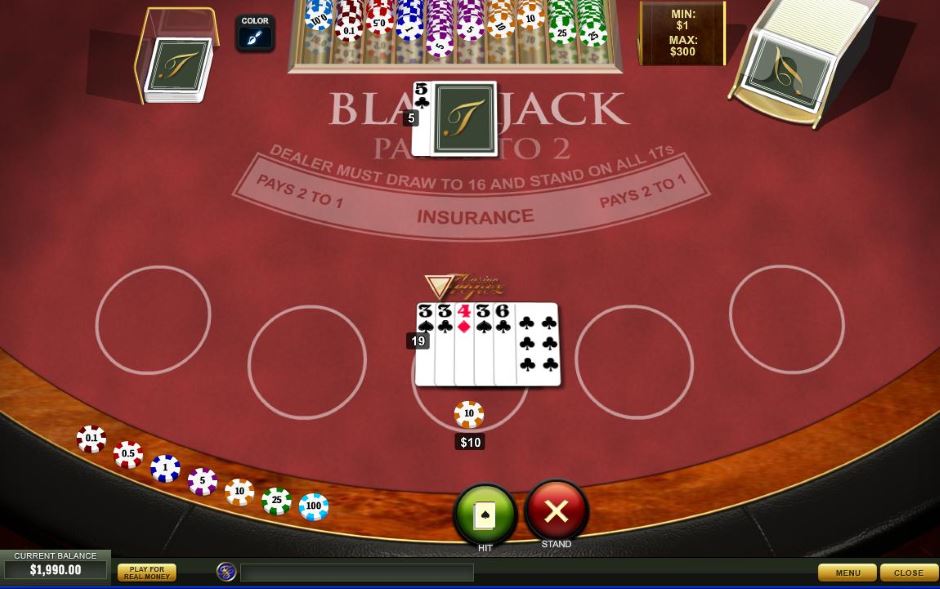
Blackjack pays 6-5: Common on single-deck games on the Las Vegas Strip, this game is a bankroll breaker for players. For example, a two-card 21 pays only $6 for a $5 bet instead of the usual $7.50, which adds 1.4 percent edge to the house--more than the usual house edge against the basic strategy of seasoned players in nearly all games with the normal 3-2 return.
Now that you know how to play, let's explore some of the finer points of the game. In the next section, you will learn the etiquette and strategy of blackjack.
How To Pick The Right Blackjack Table In One
Mathematically, where you sit at the blackjack table won’t affect the house edge. Regardless of where a player sits at the table, the casino has the same advantage over time. In the short term, you might see some specific moves that change the outcome but that tends to even out over time. Having said that many blackjack players have preferences on the best place to sit.
I’m a flexible blackjack player and don’t have much of a preference of where to sit. First base, third base, and shortstop all work depending on mood and who’s playing blackjack. Let’s look at the different positions at the blackjack table and discuss.
First Base: This seat is named because it’s the first player to see cards at the blackjack table. First base is located next to the shoe to the right of the table. Since players here are the first to receive a card and the first to act each hand they feel control over the table. Some players choose this seat because they’re experienced and don’t want another player affecting the cards they see. Other players simply like to make the first move.
Blackjack How To Deal
Third Base: This is the last seat from the shoe on the left side of the table. Third base is sometimes seen as the gatekeeper of the table. They’re the last player to act before the dealer sees their cards. In theory, they have some control over the cards the dealer sees. This player sometimes thinks that they have power over the dealer’s hand by making the right or wrong play.
Shortstop: This seat is located right in the center of the table. Shortstop doesn’t have much control of the cards other players see since there are usually players on either side. However, this player might have the most “control” of the table. This player can be positioned to possibly dissuade other players from sitting in the other position at the table.
Does Seat Position Matter?
We know that other players and seat position over time won’t change the house edge of a blackjack game. So, does seat position matter? No, and yes.
Seat position doesn’t change the game over time. Where a player sits doesn’t matter to the math over time. In the short term, you might see different cards depending on who’s sitting at the table and where you’re sitting. Depending on how many people are at the table you can see more than 100 hands per hour so the positive and negative have a good chance of evening out quicker than you think.
Card counters might prefer sitting at the third base position. This spot at the table gives the player the most time to pay attention and count other players hands. On the other side, counters might prefer getting cards quicker since they spread bets based on the count. Waiting for cards at third base could change the count. The casinos know this and might make it easier for them to catch players counting.
How Do You Play Blackjack
Many recreational players have recency bias and might have a problem with other players not using correct basic strategy. Sitting at first base might allow someone to feel comfortable since they see cards first. Meanwhile, third base might be better for someone who’s concerned about the cards the dealer plays. Sit wherever you feel most comfortable at the blackjack table.